U.S. War Declared
Collection: Documents
Title
U.S. War Declared
Scroll down to view the document; press Ctrl+F (Windows) or Cmd+F (Mac) to search within the PDF file.
Subject
World War, 1939-1945
Pearl Harbor (Hawaii), Attack on, 1941
Description
Arkansas City, Kansas newspaper account of events
Creator
Arkansas City (Kansas) newspaper
Source
Arkansas City Public Library, Arkansas City, Kansas USA
Date
12/8/1941
Rights
Published with permission from copyright holder
Format
application/pdf
Language
English
Type
Clipping
Identifier
ACPL_WWII0001
Coverage
1941
Files
Citation
Arkansas City (Kansas) newspaper, “U.S. War Declared,” SCKLS DLI Test, accessed June 6, 2026, https://test.digitalsckls.info/item/48.
Text
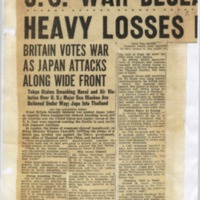
U. S. WAR
HEAVY LOSSES
BRITAIN VOTES WAR AS JAPAN ATTACKS ALONG WIDE FRONT
Tokyo Claims Smashing Naval and Air Victories Over U. S.; Major Sea Clashes Are Believed Under Way; Japs Into Thailand
(BY THE ASSOCIATED PRESS)
Great Britain formally declared war against Japan today as imperial Tokyo headquarters claimed smashing naval and air victories over the United States and mighty forces of the U. S. fleet were reported combing the Pacific to seek battle with Japanese warships.
In London, the house of commons cheered tumultously as Prime Minister Winston Churchill, fulfilling his pledge of a month ago, invoked war against the Tokyo government, made allies of Thailand and Free China, and declared:
“Every preparation in our power has. been made and we shall give a good account of ourselves.
“There is the closest accord with the powerful American naval and airforces and with the strong, efficient forces of the Netherlands East Indies.”
Some observers believed it was possible that American warships had already met Japanese naval forces in battle somewhere between Hawaii and the Philippines.
Strong Attacking Force?
One or more Japanese aircraft carriers, presumably escorted by strong naval formations, were reported to have engaged in the opening attack against Honolulu, and it seemed a fair conjecture that U. S. dreadnoughts were in hard pursuit or actual contact with the invaders.
While Japanese parachute troops were reported landing in the Philippines, Tokyo headquarters declared that two U. S. battleships had been sunk, four others damaged, two destroyers sunk and four heavy cruisers hit in the attack on Pearl Harbor.
Simultaneously, Australia decided to declare war as Japanese forces attacked the tiny British-mandated island of Nauru.
Ship Losses Claimed
An Italian broadcast quoted Domei as listing the 33,100-ton U. S. S. Pennsylvania and the Oklahoma as the American battleships sunk. Two United States destroyers and two oil tankers were also reported lost.
Japanese headquarters said a United States aircraft carrier had been sunk by a submarine off Honolulu and that many merchant ships had been captured in the Pacific.
The Tokyo announcement asserted that there were no Japanese losses in striking the heavy blows against the United States fleet at Honolulu.
The Japanese also announced an agreement between Japan and Thailand for transit of Japanese troops through Thailand—presumably for an attack on British Malaya, site of Britain’s great Far East fortress of Singapore, or British Burma. Both adjoin Thai-
Land Near Malaya Japanese troops were reported to have landed at two points on
the Gulf of Siam, far down the Thai coast near Malaya.
An official British announcement at Singapore said Japanese warcraft which landed troops at two places in British Malaya, near the Thailand frontier, had been put to flight.
Japanese forces still remaining on the beach were being heavily machine-gunned, the British said.
Domei, the Japanese news agency, was quoted as saying that Japanese and British troops already were fighting in Thailand.
A Reuters dispatch said it was announced officially in Bangkok, the Tai capital, that little Thailand had ceased resisting a Japanese invasion army temporarily and that negotiations were under way. Marines Taken At Peiping
In Manila, Admiral Thomas C. Hart, commander of the U. S. Asiatic fleet, announced that a small contingent of American marines at Peiping, China, had been forced to surrender to overwhelm-ing Japanese forces.
An NBC broadcast said the U. S. aircraft carrier Langley was reported unofficially in Manila to have been damaged in action with Japanese warplanes.
A CBS broadcast reported at least 290 casualties inflicted by high-flying Japanese planes in two attacks on the Philippines.
Manila itself apparently had escaped attack thus far.
A U. S. army bulletin said SO Japanese bombers attacked Davao on Mindanao island and bombed Baguio, the summer-time capital of the Philippines. One Japanese plane was reported shot down in Davao bay.
Situation ‘Well in Hand’
Francis B. Sayre, American high commissioner in the Philippines, declared that the situation was “well in hand.”
A WOR-Mutual broadcast from Manila, reporting that Japanese parachute troops had landed on the islands, said native Japanese had seized control of some communities but that in other sections Filipino police were rounding up the empire’s nationals.
Title
U.S. War Declared
Scroll down to view the document; press Ctrl+F (Windows) or Cmd+F (Mac) to search within the PDF file.
Subject
World War, 1939-1945
Pearl Harbor (Hawaii), Attack on, 1941
Description
Arkansas City, Kansas newspaper account of events
Creator
Arkansas City (Kansas) newspaper
Source
Arkansas City Public Library, Arkansas City, Kansas USA
Date
12/8/1941
Rights
Published with permission from copyright holder
Format
application/pdf
Language
English
Type
Clipping
Identifier
ACPL_WWII0001
Coverage
1941
Files
Citation
Arkansas City (Kansas) newspaper, “U.S. War Declared,” SCKLS DLI Test, accessed June 6, 2026, https://test.digitalsckls.info/item/48.Text
U. S. WAR
HEAVY LOSSES
BRITAIN VOTES WAR AS JAPAN ATTACKS ALONG WIDE FRONT
Tokyo Claims Smashing Naval and Air Victories Over U. S.; Major Sea Clashes Are Believed Under Way; Japs Into Thailand
(BY THE ASSOCIATED PRESS)
Great Britain formally declared war against Japan today as imperial Tokyo headquarters claimed smashing naval and air victories over the United States and mighty forces of the U. S. fleet were reported combing the Pacific to seek battle with Japanese warships.
In London, the house of commons cheered tumultously as Prime Minister Winston Churchill, fulfilling his pledge of a month ago, invoked war against the Tokyo government, made allies of Thailand and Free China, and declared:
“Every preparation in our power has. been made and we shall give a good account of ourselves.
“There is the closest accord with the powerful American naval and airforces and with the strong, efficient forces of the Netherlands East Indies.”
Some observers believed it was possible that American warships had already met Japanese naval forces in battle somewhere between Hawaii and the Philippines.
Strong Attacking Force?
One or more Japanese aircraft carriers, presumably escorted by strong naval formations, were reported to have engaged in the opening attack against Honolulu, and it seemed a fair conjecture that U. S. dreadnoughts were in hard pursuit or actual contact with the invaders.
While Japanese parachute troops were reported landing in the Philippines, Tokyo headquarters declared that two U. S. battleships had been sunk, four others damaged, two destroyers sunk and four heavy cruisers hit in the attack on Pearl Harbor.
Simultaneously, Australia decided to declare war as Japanese forces attacked the tiny British-mandated island of Nauru.
Ship Losses Claimed
An Italian broadcast quoted Domei as listing the 33,100-ton U. S. S. Pennsylvania and the Oklahoma as the American battleships sunk. Two United States destroyers and two oil tankers were also reported lost.
Japanese headquarters said a United States aircraft carrier had been sunk by a submarine off Honolulu and that many merchant ships had been captured in the Pacific.
The Tokyo announcement asserted that there were no Japanese losses in striking the heavy blows against the United States fleet at Honolulu.
The Japanese also announced an agreement between Japan and Thailand for transit of Japanese troops through Thailand—presumably for an attack on British Malaya, site of Britain’s great Far East fortress of Singapore, or British Burma. Both adjoin Thai-
Land Near Malaya Japanese troops were reported to have landed at two points on
the Gulf of Siam, far down the Thai coast near Malaya.
An official British announcement at Singapore said Japanese warcraft which landed troops at two places in British Malaya, near the Thailand frontier, had been put to flight.
Japanese forces still remaining on the beach were being heavily machine-gunned, the British said.
Domei, the Japanese news agency, was quoted as saying that Japanese and British troops already were fighting in Thailand.
A Reuters dispatch said it was announced officially in Bangkok, the Tai capital, that little Thailand had ceased resisting a Japanese invasion army temporarily and that negotiations were under way. Marines Taken At Peiping
In Manila, Admiral Thomas C. Hart, commander of the U. S. Asiatic fleet, announced that a small contingent of American marines at Peiping, China, had been forced to surrender to overwhelm-ing Japanese forces.
An NBC broadcast said the U. S. aircraft carrier Langley was reported unofficially in Manila to have been damaged in action with Japanese warplanes.
A CBS broadcast reported at least 290 casualties inflicted by high-flying Japanese planes in two attacks on the Philippines.
Manila itself apparently had escaped attack thus far.
A U. S. army bulletin said SO Japanese bombers attacked Davao on Mindanao island and bombed Baguio, the summer-time capital of the Philippines. One Japanese plane was reported shot down in Davao bay.
Situation ‘Well in Hand’
Francis B. Sayre, American high commissioner in the Philippines, declared that the situation was “well in hand.”
A WOR-Mutual broadcast from Manila, reporting that Japanese parachute troops had landed on the islands, said native Japanese had seized control of some communities but that in other sections Filipino police were rounding up the empire’s nationals.